
For most fit first-time visitors, book the standard overnight climb from Antigua, spend the first night of the trip in town, and refuse any add-on that approaches Fuego. A day hike avoids the cold camp, but it compresses a serious 3,976-meter climb into one long push and gives you less time to absorb the landscape.
Overnight or day hike?
| Choose the overnight | Choose a day hike |
|---|---|
| You want sunset, the night sky and a possible summit sunrise without turning the whole route into a race. | You sleep badly in basic cold camps and are already comfortable with long, steep days at altitude. |
| You are willing to carry layers, accept a simple camp and move slowly enough to notice altitude symptoms. | You care more about the climb than seeing Fuego after dark and have a reputable guide offering a daylight itinerary. |
| You have two clear days in the trip, plus a recovery afternoon afterward. | Your schedule cannot absorb an overnight, but it can still absorb an early start and a tired descent. |
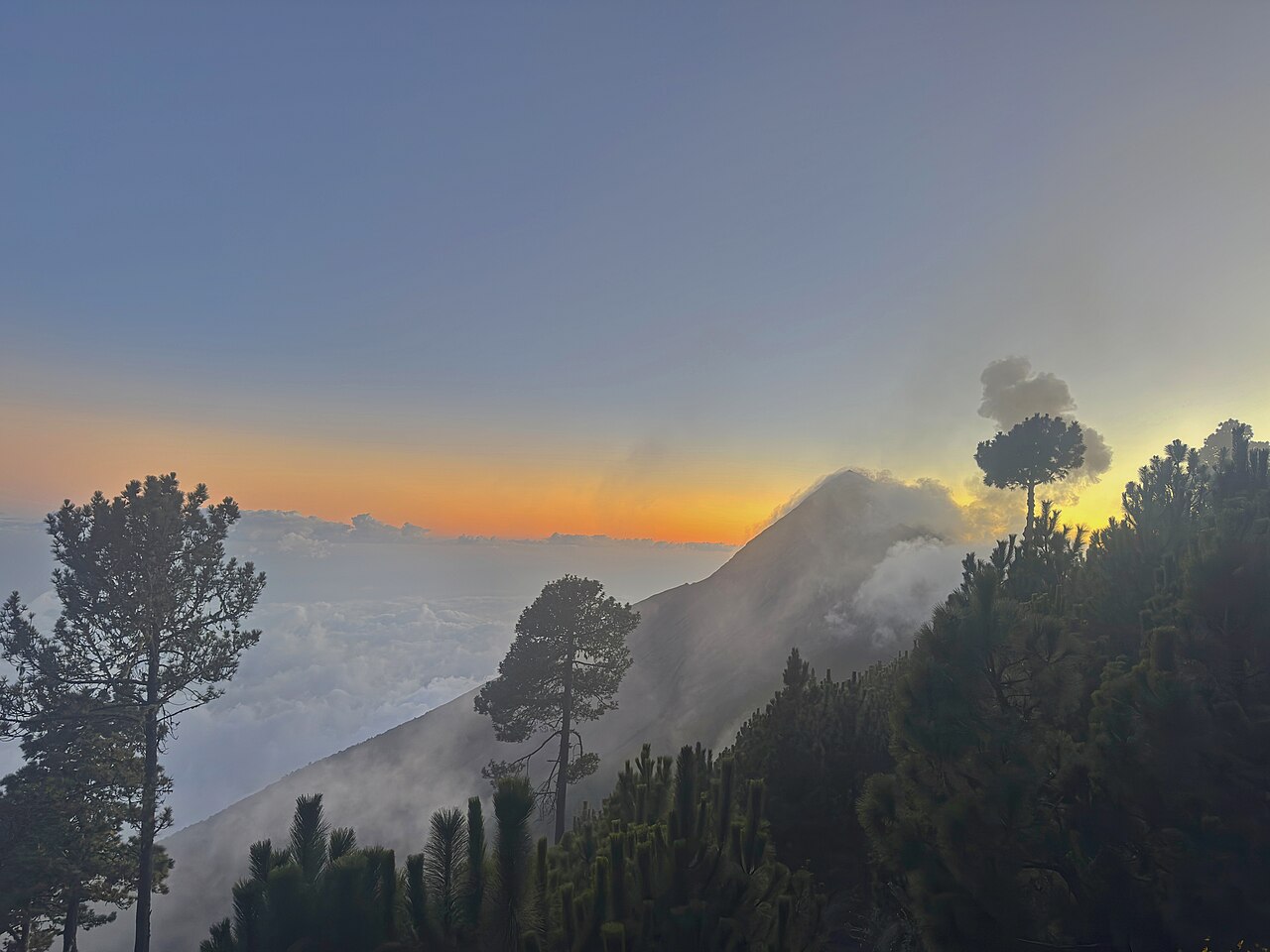
The overnight wins for most travelers because Acatenango changes character as you climb. CONAP describes a route that starts among crops, rises through pine and cloud forest, then reaches cold, windy high ground. Rushing that transition to save one night misses much of the trip.
The camp is not a guarantee of a glowing eruption. Cloud, ash direction, volcanic behavior and local restrictions decide what you see. Book the mountain, not a social-media promise.
Use Antigua as the base, not the starting gun
Antigua sits around 1,542 meters in our destination climate data, high enough to feel different from sea level but far below Acatenango's 3,976-meter summit. Give yourself at least one full night in town before climbing. Two is better if you arrived from the coast or a long flight.
Stay within an easy pickup walk of central Antigua and leave your main luggage at the accommodation. Take only the operator's packing list, water, food, layers and personal essentials. Ask where the vehicle actually collects you, whether the transfer reaches La Soledad, and what happens if weather or an official alert cancels the trip before departure.
CONAP identifies La Soledad as the park entrance reached through Chimaltenango, Parramos and San Jose Calderas. That matters when comparing operators: a vague listing that never names the trailhead is not enough.
Five questions that reveal a good operator
- Do we remain entirely on Acatenango? The answer should be clear. A February 2026 official warning specifically identified the Camellon and Meseta areas near Fuego as dangerous.
- Where is the authorized camp? CONAP says camping belongs only in authorized areas. Ask for the camp location and sleeping setup.
- How many guests are assigned to each guide? A group needs enough supervision for different paces, early descent and illness.
- What is the turnaround rule? Wind, lightning, ash, poor visibility and a struggling guest need an answer decided before summit fever arrives.
- What is included? Confirm transport, park or municipal charges, food, water, shelter, sleeping bag, headlamp, warm clothing rental and emergency communication. "Gear included" is too vague.
A two-day climb that leaves room to think
Day zero: Antigua
Arrive, eat normally, hydrate, walk rather than train hard, and repack before dinner. Read the latest CONRED and INSIVUMEH notices with the operator. If you have heart or lung disease, sleep apnea, sickle cell trait or another condition affected by altitude, the CDC advises discussing the trip with a clinician familiar with high-altitude travel.
Day one: La Soledad to camp
The transfer leaves Antigua for the La Soledad side of the park. The trail climbs steeply through cultivated land, then forest, then thinner high-country vegetation. Start slower than your legs want. Fitness does not make anyone immune to altitude illness.
At camp, change out of damp layers before the temperature drops. Eat, keep water from becoming painfully cold, and enjoy whatever view exists from the authorized site. Do not wander toward Fuego for a closer angle. In February 2026, INSIVUMEH described frequent explosive activity and warned that hot ejected material could reach the Camellon and Meseta areas used by some visitors.
Day two: summit only if the mountain agrees
A pre-dawn summit attempt is colder, windier and looser underfoot than the forest climb. Your headlamp, gloves and outer layers need to be accessible before waking. The south summit, El Plato, reaches 3,976 meters. If the guide turns around for weather, ash, visibility or group condition, that is the plan working.
Descend carefully. Loose volcanic ground punishes tired knees and careless spacing. Back in Antigua, keep the afternoon empty. A shower, food and sleep are better choices than stacking Pacaya onto the same day.
The dry months are easier, not easy
November through April is the cleaner planning window. Our 2021-2025 Antigua-base sample averages only about 10 mm of precipitation in January and 14 mm in February, compared with 344 mm in June and 249 mm in September. Those figures describe the city-base grid, not the summit. High wind, cloud, cold and ash can still erase the view in a dry month.
May through October asks more of the schedule. Rain makes the lower trail muddier, afternoon convection can shorten the safe window, and rain interacting with loose volcanic material increases lahar concern around Fuego's drainages. Build a cancellable day into the trip rather than treating a booked date as a command.
For the actual departure, use INSIVUMEH's mountain weather and Fuego wind products, the latest volcanic bulletin, and the operator's route-level decision. A general Antigua forecast cannot tell you what is happening at nearly 4,000 meters.
The no-go list
- An official restriction or local authority instruction affects the route.
- The itinerary enters the Camellon, Meseta or another Fuego approach contrary to current warnings.
- The operator cannot explain authorized camping, communications or evacuation.
- Thunderstorms, dangerous wind, heavy ash or visibility remove the summit margin.
- A headache with nausea, dizziness or unusual fatigue worsens at rest. The CDC's rule is simple: do not ascend to sleep higher with symptoms, and descend if they worsen.
- Breathlessness at rest, confusion or loss of coordination appears. Those are emergency signs, not a motivation problem.
This is not a route for proving toughness. The memorable version ends with everyone back in Antigua.
Cold camp, loose descent
Three exact pieces that earn pack space
The operator should supply shelter, sleeping equipment and a headlamp if promised. These three personal pieces solve the repeated problems: cooling down at camp, sudden wind or rain, and tired footing on descent.
Paid links. As an Amazon Associate I earn from qualifying purchases. We chose these exact models for this climb; Amazon does not determine the picks. Verify fit, availability and the operator's complete equipment list before buying.
Rab Xenair Alpine Light insulated jacket
Why this pick: Packable synthetic insulation is useful when a sweaty climb turns into a cold, inactive evening and damp air is still in the picture.
Where it earns space: Put it on as soon as you stop at camp, then carry it near the top of the pack for the summit pause.
See this pick on AmazonMarmot PreCip Eco waterproof shell
Why this pick: A compact waterproof shell blocks wind and rain without turning the ascent into a heavy expedition pack.
Where it earns space: Exposed camp, cloud-driven drizzle and the summit ridge. Wear it over insulation when wind becomes the main problem.
See this pick on AmazonLEKI Khumbu Lite trekking poles
Why this pick: Durable aluminum shafts and field-adjustable locks suit repeated use on loose, uneven mountain ground.
Where they earn space: The long descent, when fatigue and sliding volcanic soil matter more than shaving a few grams.
See this pick on AmazonThe booking decision
Choose the overnight if you can walk steeply for hours, tolerate a basic cold camp and keep the following day empty. Choose a guided day hike only if you already know that kind of effort suits you and missing the night view will not feel like a failed trip.
Whichever format you choose, stay on Acatenango. The view of an active volcano is extraordinary precisely because the hazard is real. Distance, official monitoring and a guide willing to say no are part of the experience.
Open the complete Antigua Guatemala destination guide for monthly climate, the local map, budgets and other volcano-day options. Before packing, read our guide to turning conditions data into a time-and-place decision.