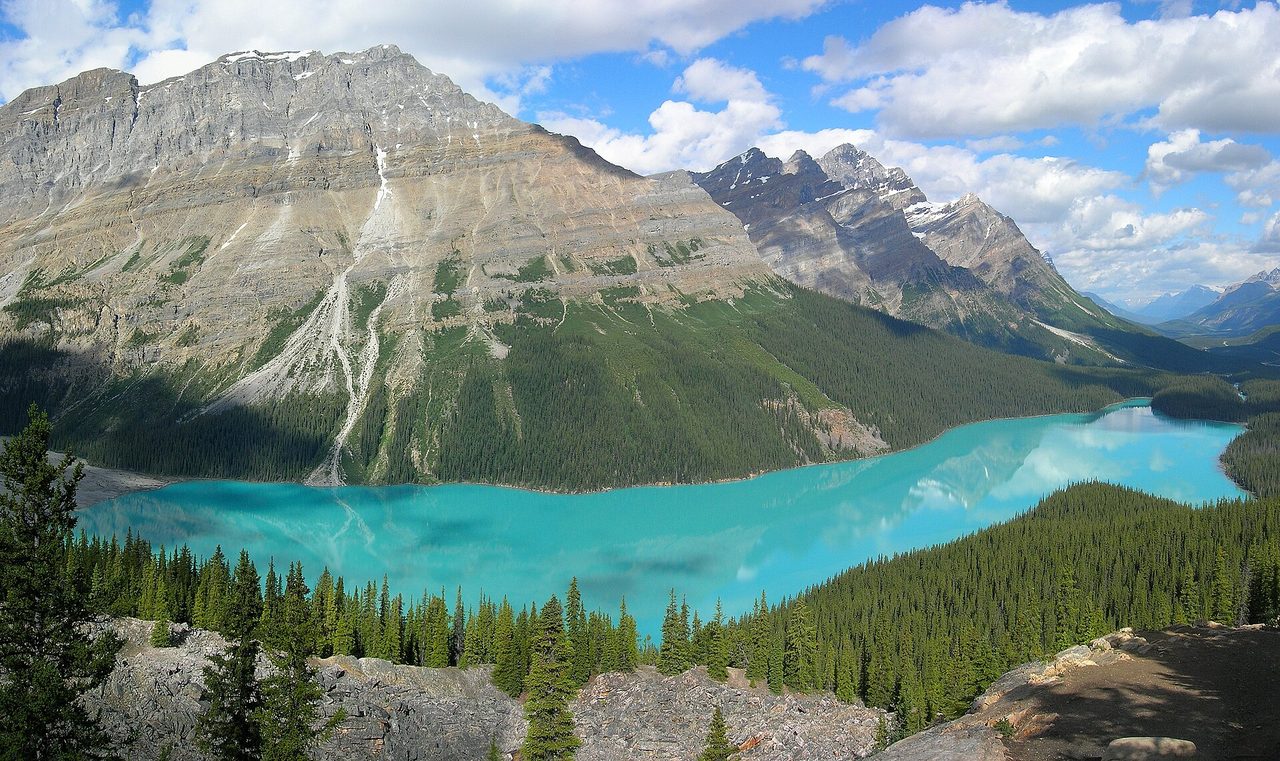
Banff's scenery is not a winter route report: this is a summer view of Peyto Lake, not a suggested winter walk. Photo: Tobias Alt, Tobi 87, CC BY-SA 4.0 · Original image. Resized from the original.
For suitable packed-snow or icy walking trails, start by comparing Kahtoola MICROspikes with Hillsound Trail Crampon Ultra. For a town-focused week, look first at NANOspikes v2 or the less expensive Yaktrax Walk. EXOspikes occupies the useful middle ground when an outing repeatedly changes surface. None is our pick for every Banff visitor.
Start with the surface you expect to walk on, then fit the traction to the boots you will actually wear. A device for icy town pavements and a set of trail spikes solve different problems; buying the more aggressive one does not automatically make it the better travel companion.
The buying boundary: this guide is for frontcountry winter walking. Slip-on traction is not a substitute for mountaineering equipment, avalanche knowledge or a current route-conditions check. It does not establish that frozen water is safe to cross; Parks Canada does not monitor natural ice for safety. If a fall could have serious consequences, change the plan rather than treating a longer spike as permission to continue.
Access check, 28 October 2026: the Johnston Canyon closure bulletin lists 13 October–11 December 2026 for the trail and day-use area, including P1 and washrooms. Separately, Roam's dated service notice suspends Route 9 from 13 October to approximately 30 November. Those dates do not promise simultaneous reopening. Check both notices before booking transport or buying equipment for that outing; this guide does not recommend a detour around the closure.
Keep, borrow or buy?
For one guided winter walk, ask the operator whether suitable traction is included, which sizes are available and whether it fits your own footwear. A confirmed loan can make more sense than buying a pair that spends the next three years in a cupboard. For several independent outings, ownership gives you time to practice fitting and removing it before the trip.
Keep your existing pair if it is the right design for the surface, still fits securely and passes the maker's inspection guidance. Look at the harness, connections and traction elements; a familiar brand name does not tell you how much life is left. Borrowing also needs a real fit check, not just a matching “Medium” label.
Find the right kind of traction first
Use the surface you expect to repeat, not the most ambitious walk in a saved itinerary. Footwear options reflect the manufacturer's published compatibility or sizing guidance; they do not guarantee that the linked Medium fits you. The exact ranges and exceptions follow each recommendation.
Paid links. As an Amazon Associate I earn from qualifying purchases. Picks use published specifications and editorial trip fit, not personal field tests. Amazon does not choose the recommendations.
Six exact Amazon US listings, titles and product photos checked 28 October 2026. Offers were visible during the check; continuing stock, seller, price, size availability and delivery are not guaranteed. These links do not establish Canadian stock or delivery. Recheck the selected model and size before payment. Shoes shown in product photos are not included. Photos load only when is enabled; analytics and advertising are separate choices.
Six traction choices
Budget bands use checked US manufacturer references, not Amazon offers or Canadian prices. “Premium” here is a price band, not a quality score. EXOspikes and NANOspikes appear only in the shoe category because that is the scope of their current maker charts; exclusion does not prove that no boot could fit. Shoe compatibility is not a recommendation to wear uninsulated shoes in cold weather.
No match for that combination
Clear the design or budget choice, or reset all filters. Do not relax the footwear-fit check or pick town traction for a trail just to produce a result. The unpriced option can be empty when all six current reference prices are known.
01Our starting point for walking trails
Product photos are optional. Use Privacy to turn on Partner product photos.
Kahtoola MICROspikes, Black Medium
Choose it for: repeated, suitable packed-snow and icy trail walks when you want a chain-and-spike design with published boot sizing.
The ordinary MICROspikes—not MICROspikes Ghost—uses 12 stainless-steel teeth per foot. We would spend the extra over a basic town coil for a trail-heavy itinerary, not for a week spent mostly between cafés and buses. Its role is traction on a suitable walk, not a higher route grade.
Maker weight: 338g per Medium pair; not a weighed travel kit.
Manufacturer US reference: US$89.95; not an Amazon offer.
Trade-off: more metal and more carrying weight than the two lower-profile Kahtoola choices. Skip it for predominantly bare pavement.
Current specifications and size chart: linked M fits hiking shoes/boots US men 8–10 or women 9–11; insulated boots men 7–9 or women 8–10.5. Check actual boot bulk and harness seating.
Product photos are optional. Use Privacy to turn on Partner product photos.
Kahtoola EXOspikes, Black Medium
Choose it for: a walking plan that keeps switching between road and trail surfaces, using footwear that matches the maker's shoe chart.
Twelve tungsten-carbide points per foot sit in an open framework. This is the pair we would compare first when the inconvenience of repeated surface changes is the buying obstacle. Its lower-profile design is not equivalent to the longer steel teeth of a trail-spike pair.
Maker weight: 208g per Medium pair.
Manufacturer US reference: US$79.95; not an Amazon offer.
Trade-off: a compromise between surface types, not our default for sustained icy trails. Skip it if the footwear you intend to use falls outside the verified fit guidance.
Current specifications and size chart: linked M covers trail-running/hiking shoes US men 8–10 or women 9–11. The chart does not supply a separate insulated-boot range. Do not borrow MICROspikes' boot range.
Product photos are optional. Use Privacy to turn on Partner product photos.
Kahtoola NANOspikes v2, Olympic Coast Medium
Choose it for: repeated icy-pavement walking, where a low-profile carbide-point design fits the plan better than a chain-and-spike model.
The revised v2 has ten tungsten-carbide points per foot. This is a more focused town recommendation than buying the most aggressive-looking traction in the shop. The upgrade over a simple coil is a different point-and-platform construction, not a claim that we measured a shorter stopping distance.
Maker weight: 210g per Medium pair for this generation, not the older 226g figure.
Manufacturer US reference: US$69.95; not an Amazon offer.
Trade-off: pavement-focused, not our hilly-trail default. Skip it if the trip is mainly sustained compact-snow hiking or you need a published insulated-boot size range.
Current specifications and size chart: Olympic Coast M, model KT05103, covers running/hiking shoes US men 8–10 or women 9–11. Do not use an old-generation weight or assume a winter boot fits because the shoe number matches.
Product photos are optional. Use Privacy to turn on Partner product photos.
Hillsound Trail Crampon, Black Medium
Choose it for: a trail walker with rigid-soled boots who specifically wants a hinged plate and an instep retention strap.
The 11-point carbon-steel design is the more substantial underfoot option here. Its plate and strap give it a different reason to exist beside MICROspikes; this is not simply another colour of the same idea. Follow Hillsound's rigid-sole recommendation rather than the broader claims you may see in marketplace copy.
Maker weight: 462g per pair, case excluded; the maker does not specify the size for that figure.
Manufacturer US reference: US$84.95; not an Amazon offer.
Trade-off: heavier and carbon steel needs rust attention. Skip it for soft, flexible shoes, mostly pavement or technical mountaineering.
Specifications and current size chart: linked M covers hiking boots US men 9–10 or women 10–11; insulated boots men 8–9 or women 9–10. Regular Trail Crampon, model TC/TCBLK3, not Ultra or Trail Crampon Pro.
Product photos are optional. Use Privacy to turn on Partner product photos.
Hillsound Trail Crampon Ultra, Medium
Choose it for: someone who wants an instep strap and chain-based trail traction with published sizing for shoes as well as boots.
Ultra uses 18 stainless-steel points and double side chains, without the standard Trail's hinged plate. At the currently checked maker price it is the less expensive trail alternative to MICROspikes. More points do not prove more grip in every condition; compare the fit and construction rather than treating the count as a test result.
Maker weight: 420g per pair, case excluded; size unspecified, so not a directly matched Medium weight comparison.
Manufacturer US reference: US$69.95; not an Amazon offer.
Trade-off: more to carry than low-profile town devices, and a strap to adjust. Skip it if a short supported outing includes suitable loan equipment.
Specifications and current size chart: linked M covers running shoes US men 11–12/women 12–13; hiking boots men 9–10/women 10–11; insulated boots men 8–9/women 9–10. Model TCU. The listing's colour field says Black while its verified photo shows a blue harness; recheck the selected item, and do not choose it for a promised colour match.
Product photos are optional. Use Privacy to turn on Partner product photos.
Yaktrax Walk Standard, Medium
Choose it for: occasional gentle town walking on packed snow or ice, when cost matters and the actual fit is confirmed.
The elastic harness and steel coils offer a much lower-cost entry point. This is Walk Standard, not Walk Plus or the strapped Pro. We would not buy it as a cheaper substitute for a chain-spike pair on sustained icy hiking trails.
Weight: exact Medium pair weight not verified from a dependable primary specification; we do not use the marketplace's erroneous 1kg figure.
Manufacturer US reference: US$22.49; not an Amazon offer.
Trade-off: the maker warns against gravel, bare concrete and snow-cleared or sanded roads. Skip it for frequent cleared-ground transitions or a trail-focused trip; remove it indoors.
Current product and sizing guidance: linked M is US men 9–11. The women's selector says 10.5–12.5, but the maker's chart says 10–12. That unresolved discrepancy makes an actual fit check especially important. For boots, the maker says add one shoe size, or two for insulated boots, before consulting the chart—not one or two device sizes.
All links select Medium, but they do not fit the same footwear sizes. Weights are manufacturer references, not our measurements; Hillsound does not identify the reference size and Yaktrax's exact Medium weight remains unknown. Read the card's full fit notes before ordering another size. Other sizes are not separately verified offers in this guide.
The linked sizes are specific examples, not universal versions. Use the manufacturer's chart for that exact model and footwear type, then try the pair on both boots before removing tags. A large insulated boot can occupy more space than a low shoe with the same nominal size. Do not convert a men's chart to women's sizing yourself or assume that all three Kahtoola harnesses use the same range.
Seat the front and heel as instructed, center the traction beneath the sole and check that the harness is not rolling off the toe or dragging underfoot. Practice on a suitable surface in gloves. If fitting it is a struggle, the solution may be another size or design—not stretching harder. Follow the maker's between-size and oversized-boot guidance, and check the retailer's return conditions before buying for a new boot.
There is also a hand-fit decision. A low-cost pair is not useful if you cannot put it on and take it off at the pavement-to-trail transition. If bending or grip strength is difficult, try the fitting process seated with assistance before travel. We have not measured fitting effort or rated these products as accessibility aids.
Build a winter walking plan, not a cleat-dependent itinerary
Parks Canada's winter-walking guidance recommends poles and ice cleats for icy trails, but also warns that even short walks can enter avalanche terrain. Its advice is to check conditions and closures, choose for the least experienced person and prepare for changing weather. No result in our product filter overrides that advice.
Think of three shopping situations. If most of your time is between accommodation, restaurants and cleared paths, low-profile town traction deserves a look. If an outing repeatedly changes between firm ground and slippery patches, mixed-surface design matters more than maximum spike length. If the plan is a permitted, suitable packed-snow or icy walking trail, a chain-and-spike model is the more relevant comparison. Deep, unconsolidated snow is a different problem: these devices do not provide snowshoe flotation.
Before leaving, check the official trail conditions and warnings and closures, and ask a visitor centre about the specific walk. Choose an earlier turnaround if anyone is uncomfortable. Carry the rest of the winter kit, including warm layers, gloves, food, water, navigation and a light; traction is only one item. Our Banff destination page and car-free planning guide help organize a base, but current operator schedules and closure notices take precedence over a general itinerary.
Pack for cold, not just slipperiness. The Town of Banff's weather-preparation advice notes that winter can run from late October to mid-April and recommends insulated boots with good tread. That seasonal window is not a forecast for your dates, and the shoe entries in a traction chart do not replace warm footwear.
Plan the transitions and the trip home
Carry traction where you can reach it before a slippery section, together with a protective pouch that keeps metal away from clothing and an inflatable item. A small cloth is useful for wet gear. Do not count a manufacturer's bare-pair weight as the complete pouch-and-accessory weight unless the specification explicitly includes them.
Remove traction before entering shops, vehicles or accommodation; exposed metal can slip on hard indoor floors and damage surfaces. Avoid unnecessary walking on bare surfaces with aggressive trail spikes. Follow the exact maker's cleaning and drying instructions after salty or wet outings, inspect for damage before reuse and store only when dry. A sealed wet pouch is for transport to a drying place, not long-term storage.
For cleaning details, use the Kahtoola model manuals, Hillsound care guide or Yaktrax instructions. Kahtoola calls for rinsing in lukewarm water and air-drying without heat; Hillsound emphasizes removing salt, complete drying and inspection, especially with the carbon-steel Trail model. Yaktrax specifies a damp cloth and air-drying. Do not generalize oiling or sharpening advice across these designs.
For flights, check the departure country's security rules and your operating airline's policy for the exact device and spike shape. CATSA lists crampons as checked-baggage only; do not assume that separate rules for sports-shoe cleats classify every removable walking device the same way. Ask about your exact pair. A friend's successful carry-on trip does not guarantee yours. Protect sharp parts and leave time to change the packing plan.
Before you buy
Are hiking boots with good tread enough?
They may be enough for dry, suitable ground, but tread is not the same thing as added traction on ice. First decide whether the walk is appropriate in the conditions; then choose footwear and traction together. Cleats do not add boot insulation or waterproofing.
Should a beginner buy the most aggressive model?
No. Choose a shorter, appropriate outing and a device you can fit and use correctly. Longer spikes add their own walking and packing compromises. They do not turn a steep, exposed or closed route into a beginner route.
Does “crampon” mean mountaineering equipment here?
No. Product names can include that word without describing a technical mountaineering crampon system. The slip-on walking models in this comparison are not a recommendation for ice climbing, glaciers or consequential steep snow. Get activity-specific guidance and equipment for those trips.
Can one pair cover town and trails?
Sometimes, if its intended surfaces and fit match the actual itinerary. The compromise is more important than the label: a low-profile design may be convenient around town but is not the same tool as a chain-and-spike trail pair. If your week is mostly town with one guided outing, asking about a loan for that outing can avoid buying two pairs.
Should I order from these US links for a Canadian trip?
Only after checking delivery timing, currency, import costs and returns. An Amazon US listing is not evidence of Canadian inventory or local delivery. Buying where you can fit the device on your boots may be worth more than a small price difference. None of the reference prices in this guide is a live Amazon offer.
How we chose
These are editorial judgments from manufacturer specifications, exact listing checks and the walking situations above—not personal field tests, traction measurements or a ranking by review score. We prioritize the intended surface and a demonstrable fit over the most dramatic claim on a product box. See our research method. Next scheduled editorial review: 28 April 2027; access and transport should be checked again before every trip.