
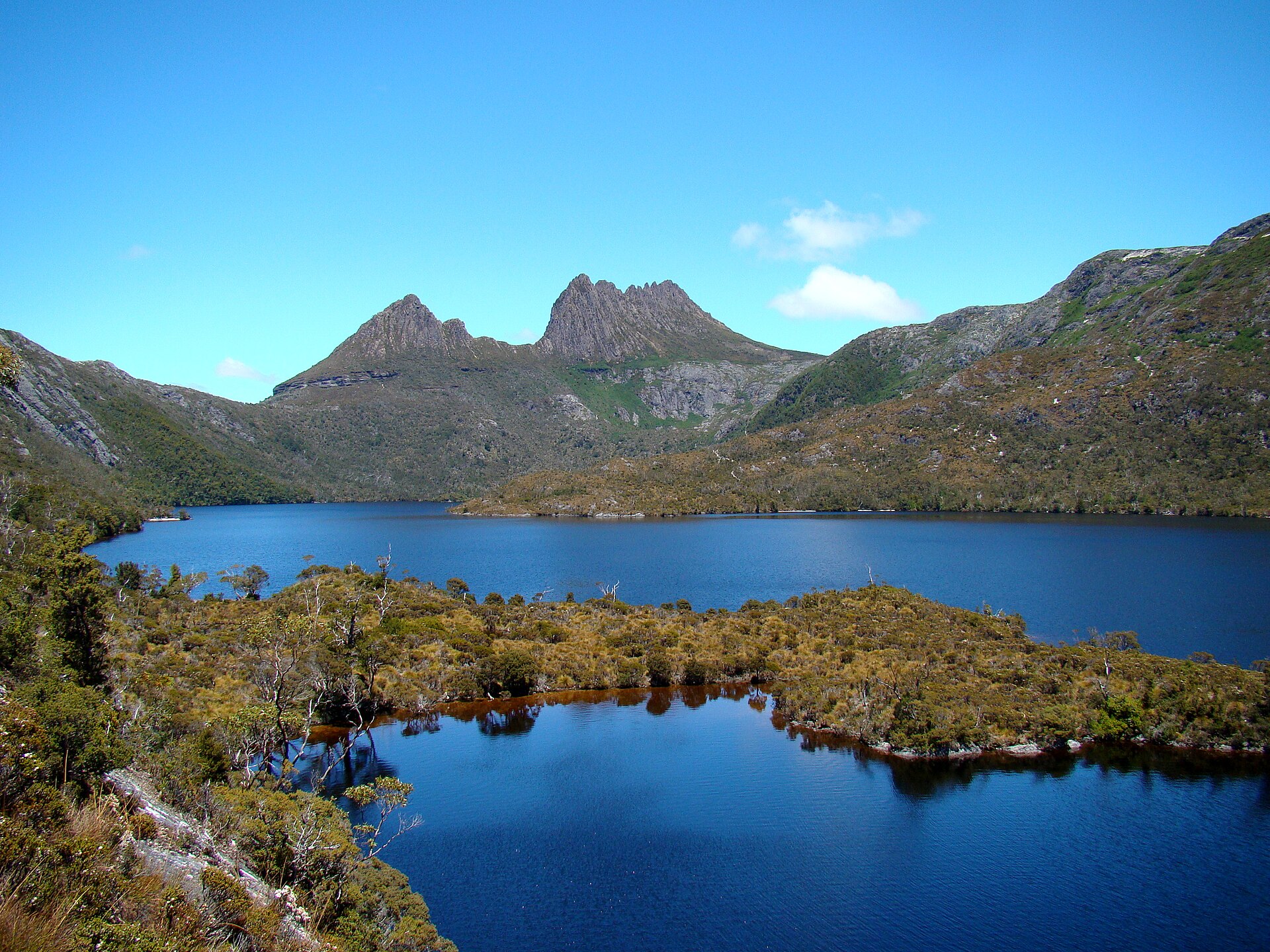
For most first visits, we would book three nights at Cradle Mountain and day hike. You can give the clearest, calmest day to Marion’s Lookout or the summit, use Dove Lake when the cloud lowers, and still see the landscape you came for. Choose the Overland Track when carrying six days of food and equipment through remote alpine weather is the reason for the trip—not because it sounds like the “complete” way to visit Cradle Mountain.
These are two different holidays
| Trip shape | Choose it when | What you give up |
|---|---|---|
| Three-night Cradle Mountain base Two full walking days | You want the lake, lookout and perhaps the summit; weather flexibility matters; or the group has mixed ability. | You return to the same valley each evening. You do not reach the changing forests, plateaus and southern end of the national park on foot. |
| Overland Track Usually six walking days, plus transport time | You already enjoy self-supported multi-day walking, can carry shelter and food, and want the traverse itself more than a summit photo. | Spontaneity. In the main season you commit to a departure, north-to-south route and point-to-point transport before the forecast is useful. |
The park describes the Overland Track as 65 km before optional side trips. Most walkers take six days. Nearly half is above 1,000 metres, huts are not reserved, and independent walkers must still carry a tent. At the southern end, the usual finish at Narcissus Hut needs a pre-booked ferry across Lake St Clair—or another 17.5 km on foot. There is no road through the park connecting Cradle Mountain and Lake St Clair.
Three nights: let the mountain choose the order
Arrival day: make the next morning easy. Reach Cradle Mountain while the visitor centre is open if you need a parks pass or shuttle help. Take the 1.1 km Enchanted Walk if daylight and energy allow, then put shell, warm layer, food, water, headlamp and map together before bed. The village has limited groceries and services; this is not the night to discover that lunch is still in Launceston.
Best-weather day: earn the high route. The summit is a Grade 5 day—12.8 km return, roughly eight hours and 600 metres of climbing—with large-rock crossings near the top. It belongs only in fine weather and with enough daylight. If exposure, boulders or the forecast make the summit a bad fit, Marion’s Lookout gives you a high view without turning around feeling like you settled. A lower objective is good mountain judgment, not a failed summit.
Cloudier day: walk Dove Lake clockwise. The official circuit is 6 km, Grade 3 and usually takes two to three hours. Forest, lake and mountain-edge scenery make it worthwhile even when the summit hides. If wind and rain are already punishing the lake, the 5.7 km Crater Lake circuit is the park’s own lower-altitude alternative, and the short valley walks keep the day alive without forcing a serious objective.
This order also works for a family or mixed group: share Dove Lake, then split only for the harder day. Add a fourth night if the summit truly matters. One spare morning is more useful than fixing a Grade 5 route to the one day you happen to have.
The Overland Track begins before day one
For the 2026/27 booking season, the park lists the main season from 1 October through 31 May and an adult Overland Track fee of AU$312. The fee and rules are reviewed, so treat that number as a checked planning reference, not a future quote. Only 34 independent walkers can depart each day. Book the walking date first, then solve both ends of the route.
- Sleep at Cradle Mountain the night before. Parks recommends this because check-in, the walker briefing, the shuttle to Ronny Creek and the four-to-six-hour first stage do not combine well with a same-morning cross-island transfer.
- Reserve the south-end exit. Book the Lake St Clair ferry if you intend to finish at Narcissus. If you prefer to walk the lake shore, add a seventh walking day rather than quietly attaching 17.5 km to day six.
- Keep transport margin on both sides. The park says many walkers plan a spare logistics day before and after. The track is north-to-south in the main season, and Cradle Mountain is not a round-trip trailhead.
- Carry the complete safety system. A hut is welcome shelter, not a reservation. Carry the tent, fuel stove, food, navigation, waterproofing and emergency equipment on the park checklist, and know how to use them.
A sensible six-day rhythm follows the official hut sequence rather than trying to “win” the track: Waterfall Valley, Lake Windermere, Pelion, Kia Ora, Windy Ridge and Narcissus. Side trips are bonuses. Cradle Mountain, Barn Bluff and Mount Ossa should be removed from the day when weather, snow, fatigue or visibility says no.
January and February buy the best odds, not certainty
Our 2021–2025 Cradle Mountain climate sample makes January and February the easiest starting point for a first hiking trip. January averaged a 17°C daytime high and 109 mm of monthly precipitation; February was about 16°C with 79 mm. Those are mild alpine numbers, not dry-country promises. Tasmania Parks warns that severe cold, wet and wind can occur in any month, including summer.
- December to March: longest useful daylight and the friendliest temperature range. This is the most forgiving window for day hikers and first-time Overland walkers, but also the period to book early.
- April: cooler days, autumn color and shorter margins. Treat summit timing and wet layers more conservatively.
- May to September: this is not the cheap version of summer. Snow, ice, short daylight and winter registration change the skills and equipment required.
- October and November: spring can still feel wintry. Our sample averaged 226 mm in October and 172 mm in November, so do not let the booking-season label choose your clothing.
The shuttle is part of the hiking day
During shuttle hours, private vehicles are restricted on Dove Lake Road. Start at the visitor centre, validate the parks pass and arrange the shuttle ticket; the ride to Dove Lake takes about 20 minutes. The 2026 timetable changes through the year, with longer service in summer and earlier last departures in winter. Check the current finish time before taking a route that returns to a different stop.
Launceston, Devonport and Hobart have transfer options, but Cradle Mountain is not a casual commuter base. If you rent a car, leave wildlife-heavy night driving out of the plan. If you arrive by coach, confirm the exact accommodation stop and whether you can reach food, the visitor centre and your return pickup without a vehicle.
A summit forecast is not a valley forecast with a colder number
Check the Bureau of Meteorology forecast and bushwalker warnings, then ask the visitor centre what the track is doing—not only what the sky looks like from the car park. Cloud can erase navigation cues, wet rock changes the scramble, and wind can make an exposed route unreasonable long before rain becomes dramatic.
Carry a waterproof shell in every season, plus warm clothing, food, water, headlamp, map, first-aid supplies and a charged phone. For remote walking, Tasmania Parks and Police both recommend a Personal Locator Beacon; a phone is not a substitute for an emergency device or offline navigation. Leave your route and return time with someone, use the logbooks, and turn around while the decision is still yours.
Wet trail, cold stop, long descent
Three exact pieces that solve Cradle Mountain problems
This is not the complete Overland Track packing list. These are three personal pieces that also make sense on the day-hike plan; remote walkers still need the park’s full shelter, sleep, cooking, navigation and emergency system.
Paid links. As an Amazon Associate I earn from qualifying purchases. We chose these exact products for this plan; Amazon does not determine the picks. Check fit and availability before buying.
The exact listings and product images were checked on Amazon US on 25 August 2026. Buy or hire locally when fit, delivery, baggage or returns make more sense.
Marmot PreCip Eco waterproof shell
Why this pick: A packable waterproof shell with pit zips is easier to regulate on a climb than a heavy travel raincoat and still belongs in the pack on a bright morning.
Where it earns space: Wind-driven rain around Dove Lake, exposed time above Marion’s Lookout and every Overland day when staying dry is part of staying warm. It is one layer, not the whole weather system.
See this pick on AmazonRab Xenair Alpine Light insulated jacket
Why this pick: Lightweight synthetic insulation is a practical match for damp, stop-start mountain days and is easier to layer under a shell than a bulky town jacket.
Where it earns space: Shuttle waits, lunch above the lake and the first minutes after arriving at an Overland hut. Put it on before the chill arrives; keep a dry camp layer protected on multi-day trips.
See this pick on AmazonLEKI Khumbu Lite trekking poles
Why this pick: Aluminum shafts and field-adjustable locks favor dependable repeated use over a fragile ultralight compromise.
Where they earn space: Mud, steps and the accumulated descents of the Overland Track. Stow them for summit boulders and anywhere hands or precise foot placement matter more.
See this pick on AmazonWhy you will not see an activity card here
The current Viator inventory does not offer a Cradle Mountain product that matches this decision closely enough to earn a place in the plan. A vague Tasmania tour would not solve your Overland booking, south-end transport or summit-day choice. For day hikes, book the park pass and shuttle directly through the official system. For the traverse, start with the official Overland Track booking and build transport around that date.
The simple answer
Choose three nights and day hikes if this is your first Cradle Mountain visit, if anyone in the group wants a warm room, or if the summit is the priority. Choose the Overland Track when you want six self-supported days more than any single viewpoint—and when carrying the full safety system already feels like part of the adventure.
Open the Cradle Mountain destination guide for month-by-month temperatures, precipitation, mapped activity areas and local cost context. Read how to turn changing conditions into a go, adjust or stop decision before fixing the hardest walk to a calendar square.