
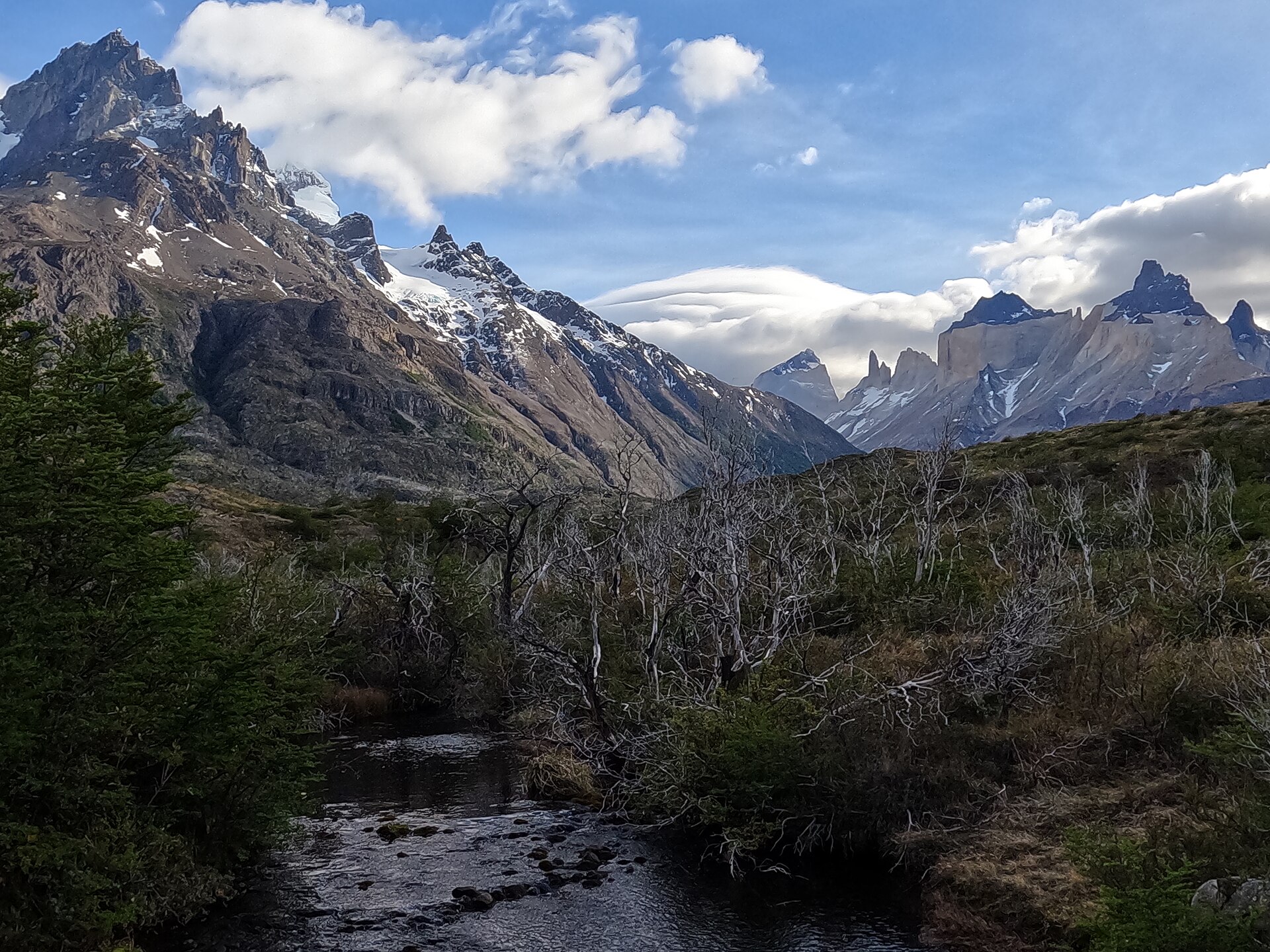
Book the W when you have five trail days, four confirmed nights inside the park and a group that is happy to keep moving even when the famous view disappears into cloud. Stay in Puerto Natales when you have fewer than five days, mixed hiking appetites, remote-work commitments or a strong preference for changing the plan after you see the forecast.
The W and the day-trip version are different holidays
| Choose the W trek | Choose a Puerto Natales base |
|---|---|
| You want four to six days of continuous walking, and carrying or paying for your overnight system feels like part of the experience. | You want Base Torres, big roadside viewpoints and a glacier day without sleeping in a different bed every night. |
| You can reserve every required refuge or campsite before entering the mountain area and accept that those reservations set the shape of the week. | You need to move strenuous days around weather, work or recovery, and you are comfortable spending about two hours on the road each way to reach the park. |
| Your group walks at a compatible pace and can manage repeated full days with no simple taxi exit from the interior. | Your group is mixed: one person wants an eight-hour hike while another would rather use the scenic road, short viewpoints or a guided outing. |
The W links the Ascencio, Francés and Grey valleys. It is not a collection of three interchangeable day hikes. CONAF requires confirmed accommodation or camping for every W overnight before you enter the mountain area. That rule is what makes a continuous circuit work—and what makes a casual, last-minute version fall apart.
Book in the order that can actually fail
- Find a complete chain of authorized beds or campsites. Inventory is split among concessionaires. Put the nights on one calendar before paying; a beautiful first and fourth night do not solve a missing middle.
- Choose the direction around that inventory. Our default is west to east: Paine Grande and Grey first, then the Francés valley, then Central and an early Base Torres finish. The final morning starts near the trail instead of gambling on a same-day bus arrival.
- Buy the correct park pass. The park now distinguishes full-day, Base Torres, W and Macizo Paine itineraries. The official reservation page says entry must be purchased at least 24 hours before arrival; earlier is wiser once the overnight chain is fixed.
- Match buses, internal connections and the Pehoé catamaran to the route. Bus-Sur publishes separate high-, low- and peak-season timetables. Do not build the trip from an old blog screenshot.
- Protect the night before and after. Puerto Natales is where you buy food, settle rental issues, repack and sleep after a delayed flight. It should not be a same-day airport-to-trail sprint.
A reservation confirmation is not permission to ignore the daily trail report. Rangers can close or restrict a section for wind, flooding, snow or another operational problem. The booking gives you a place to sleep if the route is open; it does not make the route open.
A five-day W that leaves the best finish in reach
This is a planning shape, not a promise that the ferry, trail and beds will line up on your dates. Start with the confirmed inventory and current timetables, then preserve the logic.
- Day 1 — Pudeto to Paine Grande, then toward Grey: take the first practical Puerto Natales connection, cross Lake Pehoé and continue only as far as the ferry arrival, trail cutoff and your booked bed allow. If Grey would require racing, sleep at Paine Grande and move the glacier leg to the next morning.
- Day 2 — Grey to Paine Grande: use the morning for the glacier side of the W, then return toward Paine Grande. This keeps the next day's Francés valley decision independent of a boat arrival.
- Day 3 — Francés valley to Francés or Cuernos: decide between the Francés and Británico viewpoints at the ranger checkpoint, not weeks earlier. Cloud, wind, pace and the published cutoff should make that choice.
- Day 4 — Cuernos or Francés to Central: this is the transition day. Eat, dry layers and set the alarm for Base Torres instead of adding mileage because the map looks short.
- Day 5 — Base Torres, then Puerto Natales: start early from the Central sector, turn around at the posted time and use a departure connection you can realistically make. If transport does not leave enough margin, add a fifth park night rather than turning the descent into a race.
Why finish here? Base Torres is the part most vulnerable to a late same-day arrival from Puerto Natales. Sleeping near the eastern trailhead gives you daylight and removes one vehicle connection from the morning. The tradeoff is simple: the marquee view becomes the final objective, so a closure may take it away. That is still better than pretending a reservation can overrule weather.
The Puerto Natales plan: three park days, not three copies of the same tour
Day one is Base Torres. Use a dedicated transfer or an itinerary that clearly reaches the current entry cutoff. CONAF describes this as an eight-hour, medium-to-high difficulty return day. In winter conditions, an accredited specialist guide is mandatory; rules can extend when conditions demand it.
Day two is a scenic-road and short-walk day. The park's vehicle route has six interpreted viewpoints. This is the right answer after tired legs, low cloud on the high trail or a mixed-ability group. It is not a consolation prize: you see the massif from changing angles instead of spending another day in one valley.
Day three is the western park. Pair the Pehoé crossing, Paine Grande area or a Grey Glacier outing only when the published boat and bus connections create a comfortable return. A navigation cancellation can strand the itinerary, so keep the fourth regional day unbooked.
Back in town, use the waterfront, groceries and café time as recovery—not as proof that you failed to maximize Patagonia. A day-trip base works because the hard day can be followed by a normal bed, dry gear and a late breakfast.
Summer is the straightforward first trip; winter is a different operation
Chile's tourism authority describes the W as a four-to-six-day route with hiking days that can reach eight hours. For a first self-guided attempt, use the main summer operating season and verify the exact opening dates of every refuge, campsite and transport leg. Longer daylight helps, but it does not remove trail cutoffs or wind closures.
Nuevo Adventure's 2021–2025 Puerto Natales climate sample puts a typical January high near 15°C and low near 8°C. That describes the town model, not the exposed trail. The park can feel colder, wetter and dramatically windier within the same day. Pack for the mountain, then enjoy being overdressed when Natales gives you sun.
Do not treat May through August as a discounted version of summer. CONAF's 2026 winter rules closed the W in June and July, required specialized guides for the W during its restricted winter operation, and kept the Macizo Paine circuit closed through October. The exact dates can change every year. If winter Patagonia is the goal, choose the authorized guide and operating itinerary first; flights come later.
The decisions that matter after the booking
- Walk only in daylight and stay on authorized trails. CONAF prohibits leaving the marked route and camping outside authorized sites.
- Register where required and respect every cutoff. A ranger may stop the day even when you feel strong. That protects the time needed to reach the next safe stop before darkness.
- Expect no useful connection in the interior. The park warns that W and Macizo hikers spend days without phone or internet service. Download confirmations and emergency information before leaving town.
- Keep fire out of the plan. Smoking is prohibited, and cooking is limited to permitted equipment and designated areas under current rules. One careless flame has consequences far beyond your dinner.
- Do not split the group to rescue the schedule. CONAF notes that emergency help can take hours. The slower pace, blister or early turnaround belongs to the whole group.
Pack for wind, wet and long descents
Three pieces that keep earning their space
Torres del Paine does not need a novelty packing list. It needs layers that work while moving, reliable poles for repeated descents and enough margin to stop without becoming cold.
Paid links. As an Amazon Associate I earn from qualifying purchases. We chose these exact models for this itinerary; Amazon does not determine the picks. Verify fit and local availability before buying, and follow your guide or refuge instructions for technical equipment.
These exact listings were verified on Amazon US on 19 August 2026. In Chile, buy the same model locally when delivery, returns or fit make more sense than importing.
Marmot PreCip Eco waterproof shell
Why this pick: A proven packable shell gives you a real waterproof layer without using most of the daypack.
Where it earns space: The exposed Francés valley, spray near Grey and every quick stop where wind turns a manageable drizzle into lost heat. Carry it even when Natales wakes up bright.
See this pick on AmazonLEKI Khumbu Lite trekking poles
Why this pick: Strong aluminum shafts and field-adjustable locks are a better Patagonia bargain than fragile ultralight poles.
Where they earn space: The long Base Torres descent, wet roots and the fourth morning when your knees remember every kilometer. Pack them away when wind or terrain makes pole placement awkward.
See this pick on AmazonRab Xenair Alpine Light insulated jacket
Why this pick: Packable synthetic insulation handles stop-start mountain days and damp air better than carrying a bulky town coat.
Where it earns space: Ferry waits, early starts at Central and the moment you stop moving at a viewpoint. Put it on before you feel cold, then protect it under the shell.
See this pick on AmazonThe final decision
Choose the W when you would still want the trek after removing the guarantee of blue-sky photos. The reward is continuity: waking inside the park, watching the terrain change and finishing a route rather than collecting viewpoints.
Choose Puerto Natales when the people, weather or work need flexibility. Base Torres plus a western-park day and one scenic-road day is a complete first trip. It gives you three different ways to understand the massif—and room to return when Patagonia says no.
Open the Puerto Natales destination guide for the monthly climate, mapped activity areas, town budget and connectivity context. Browse all human-reviewed planning guides, or read how we separate historical data from facts that must be rechecked.